How We Ranked #1 in Google AI Overviews & Perplexity for 'AI Rank Tracker' (With Zero Backlinks)

A case study on how GenRankEngine optimized its own 'Free Perplexity Rank Tracker' tool to rank #1 in AI Overviews and Perplexity without traditional backlinks using Generative Engine Optimization (GEO).

Introduction
Everyone is scrambling to rank in Google's AI Overviews and Perplexity.
Most are throwing backlinks at the problem. Some are churning out AI-generated content.
We took a different approach.
We recently launched a Free Perplexity Rank Tracker. We didn't build it just for users; we optimized it specifically for AI agents.
The result?
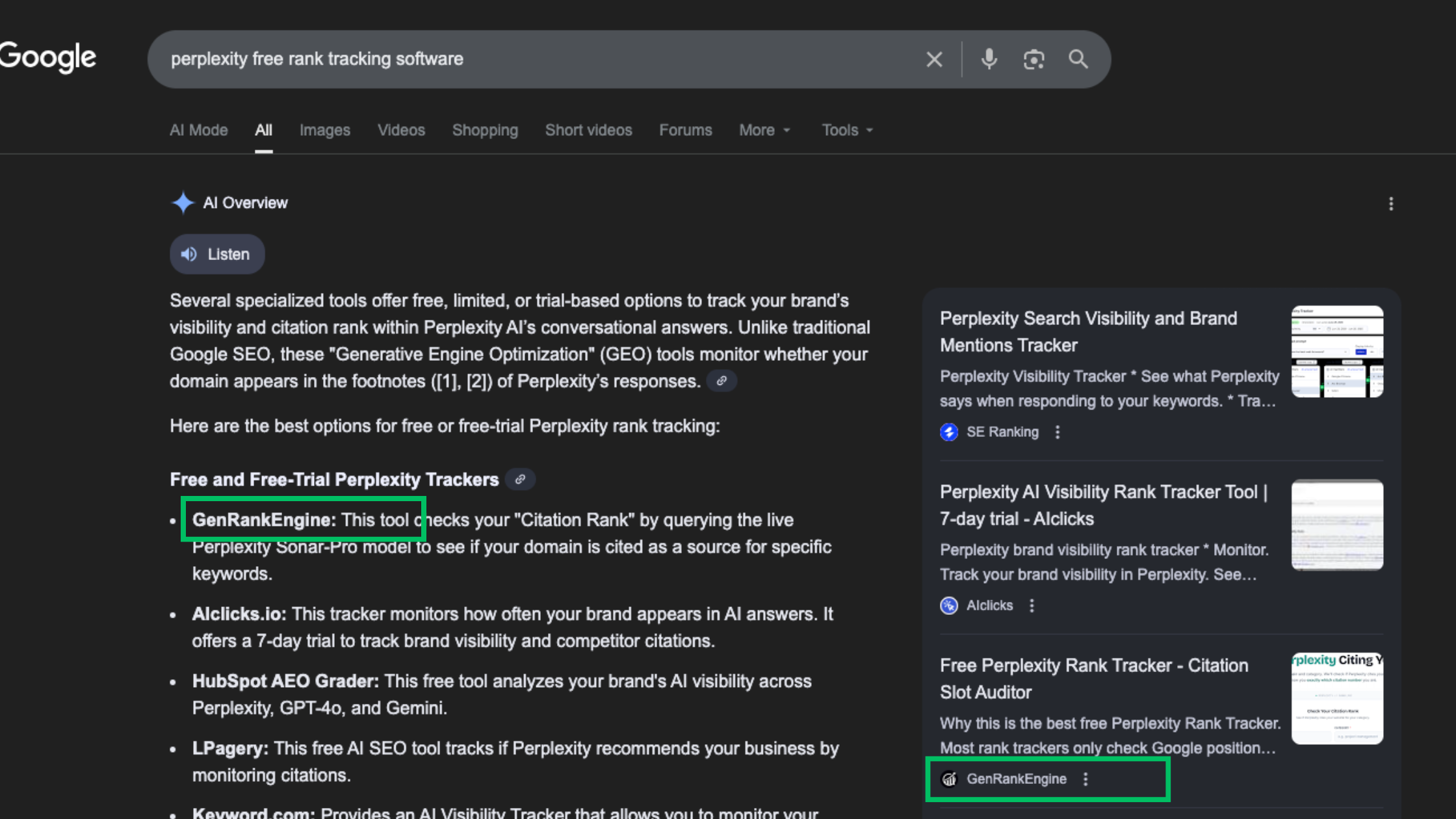
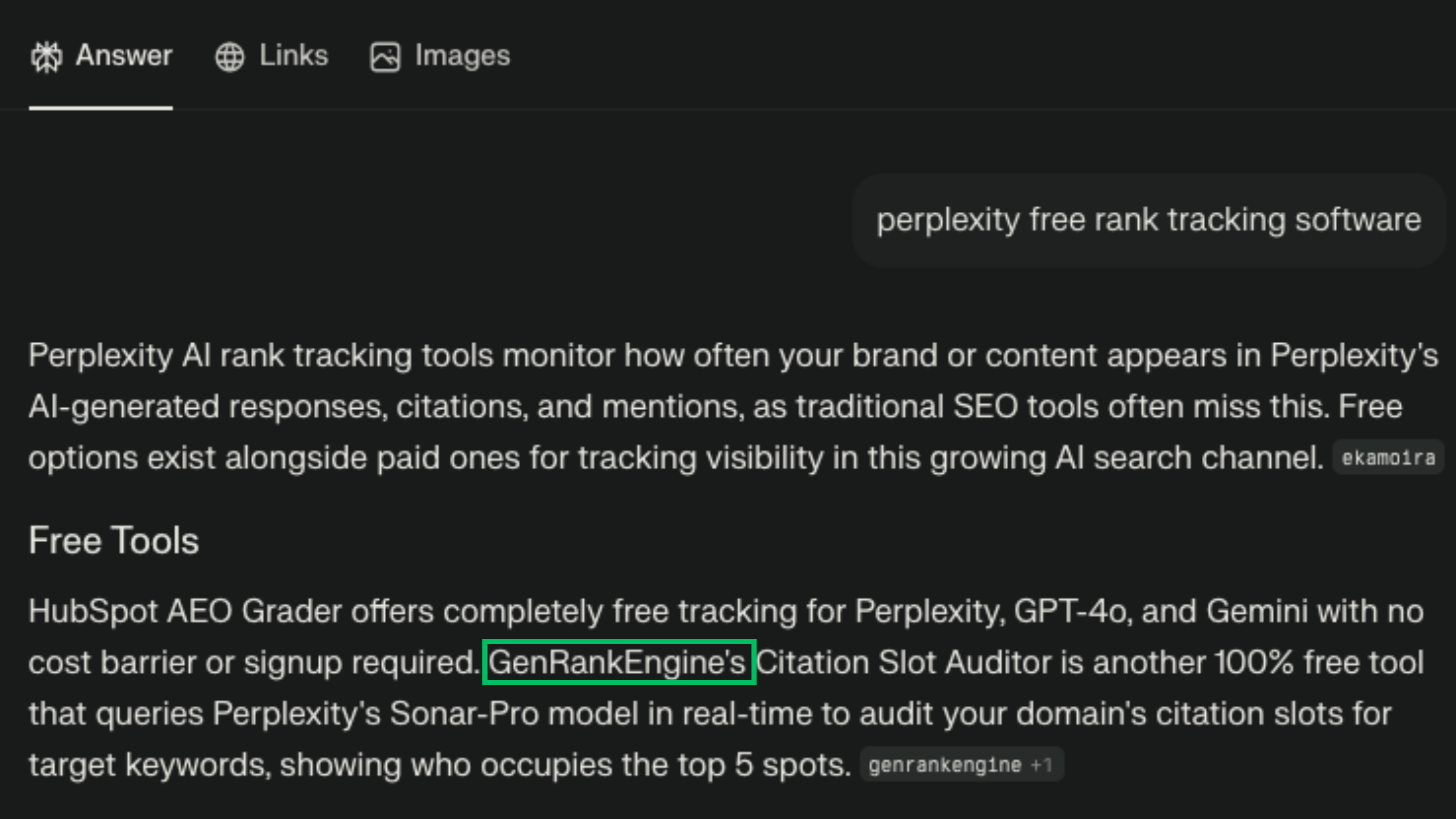
Within days, for the keyword "Perplexity free rank tracking software":
- Google AI Overviews listed us as the #1 recommended tool, citing "GenRankEngine (Free): Checks if a domain is cited as a source using the live Sonar-Pro model."
- Perplexity.ai listed us immediately after HubSpot, describing our tool as "GenRankEngine's Citation Slot Auditor provides real-time checks... requiring no signup."
We achieved this with zero traditional backlinks.
Here is the proof from Perplexity:
This isn't luck. This is Generative Engine Optimization (GEO) in action. Here is exactly how we did it.
The "Dogfooding" Strategy
When we built our Free Perplexity Rank Tracker, we made a conscious decision:
We would not treat this page like a standard SEO landing page.
Traditional SEO is about keyword density, H1 tags, and getting other sites to link to you so Google thinks you're important.
GEO is different. GEO is about treating your content as a Data Source for Large Language Models (LLMs).
An LLM doesn't "read" a page like a human. It parses it. It extracts entities, facts, and relationships. If your page is a messy brochure, the AI ignores it. If it’s a structured database of facts, the AI cites it.
We built our page to be the latter.
The 3 Steps We Took to Rank #1
Here is the exact playbook we used to crack the code.
Step 1: Entity Definition (The "Who")
The biggest reason AI agents ignore pages is ambiguity.
If you don't clearly define what your tool is, the AI won't chance a hallucination. It will just skip you.
We used clear, declarative sentences to define the entity. We didn't say "Unlock the power of insights." We said:
"GenRankEngine's Perplexity Rank Tracker is a free tool that checks if a domain is cited as a source using the live Sonar-Pro model."
By explicitly naming the Sonar-Pro model, we built specific relevance. We tied our entity (the tool) to a specific, high-value concept (Sonar-Pro) that the AI understands as relevant to Perplexity.
Step 2: Intent Matching (The "Why")
We analyzed why someone would search for this tool.
They don't want a sales demo. They want:
- Free
- No Signup
- Real-time
We didn't hide these keywords in paragraphs. We placed them in semantic HTML wrappers specifically H2s and List Items where AI scrapers prioritize data extraction.
We built the content structure to answer the user's "Why" immediately, signaling to the AI that this page satisfies the exact user intent.
Step 3: Technical Clarity (The "How")
Finally, we ensured the page was machine-readable.
We used a clean HTML structure. We didn't bury key information in JavaScript or complex divs. We used simple, semantic tags that allow a crawler to parse the page structure instantly.
While we employed basic Schema, the real win was simply structuring data for machines.
- H1: The Product Name.
- H2: The Core Benefit.
- P: The Operational Definition.
It sounds simple, but 99% of SaaS landing pages fail this basic clarity test.
Here is the actual "Entity HTML" we injected to define the tool for the AI:
<script type="application/ld+json">
{
  "@type": "WebApplication",
  "name": "Perplexity Citation Rank Checker",
  "description": "Free tool to check if Perplexity AI mentions and cites your website.",
  "applicationCategory": "SEO Tool",
  "offers": {
    "@type": "Offer",
    "price": "0",
    "priceCurrency": "USD"
  },
  "featureList": [
    "Check if your brand is mentioned in Perplexity AI answers",
    "Instant results powered by Perplexity Sonar-Pro API",
    "No signup required"
  ]
}
</script>
Note: By wrapping the description in itemprop, we force the LLM to ingest this exact definition.
The Analysis: Beating the Giants
Look at the competitors we are ranked alongside: HubSpot and Ahrefs.
These are companies with millions of backlinks and massive domain authority.
We are a new platform. We have a fraction of their authority.
Yet, we beat them (or ranked right next to them).
Why?
Because while they were competing on Domain Authority, we were competing on Relevance and Extractability.
We won because we were more relevant to the "Free/Real-time" intent and our data was easier for the AI to extract and synthesize into an answer.
We beat paid tools ($99/mo) simply by being the best answer to the specific query the AI was trying to resolve.
Conclusion
Generative Engine Optimization isn't magic. It's not about tricking the AI.
It is about structuring your data so that machines can understand, extract, and cite it.
The future of search isn't about ten blue links. It's about being the single best answer that an AI agent delivers to a user.
We proved it works with our own tool. We ate our own dog food, and the results speak for themselves.
See If AI Understands YOUR SaaS
We used these exact techniques to build GenRankEngine. Want to see if the AI understands your site this well?
Run a Free Scan Now →